
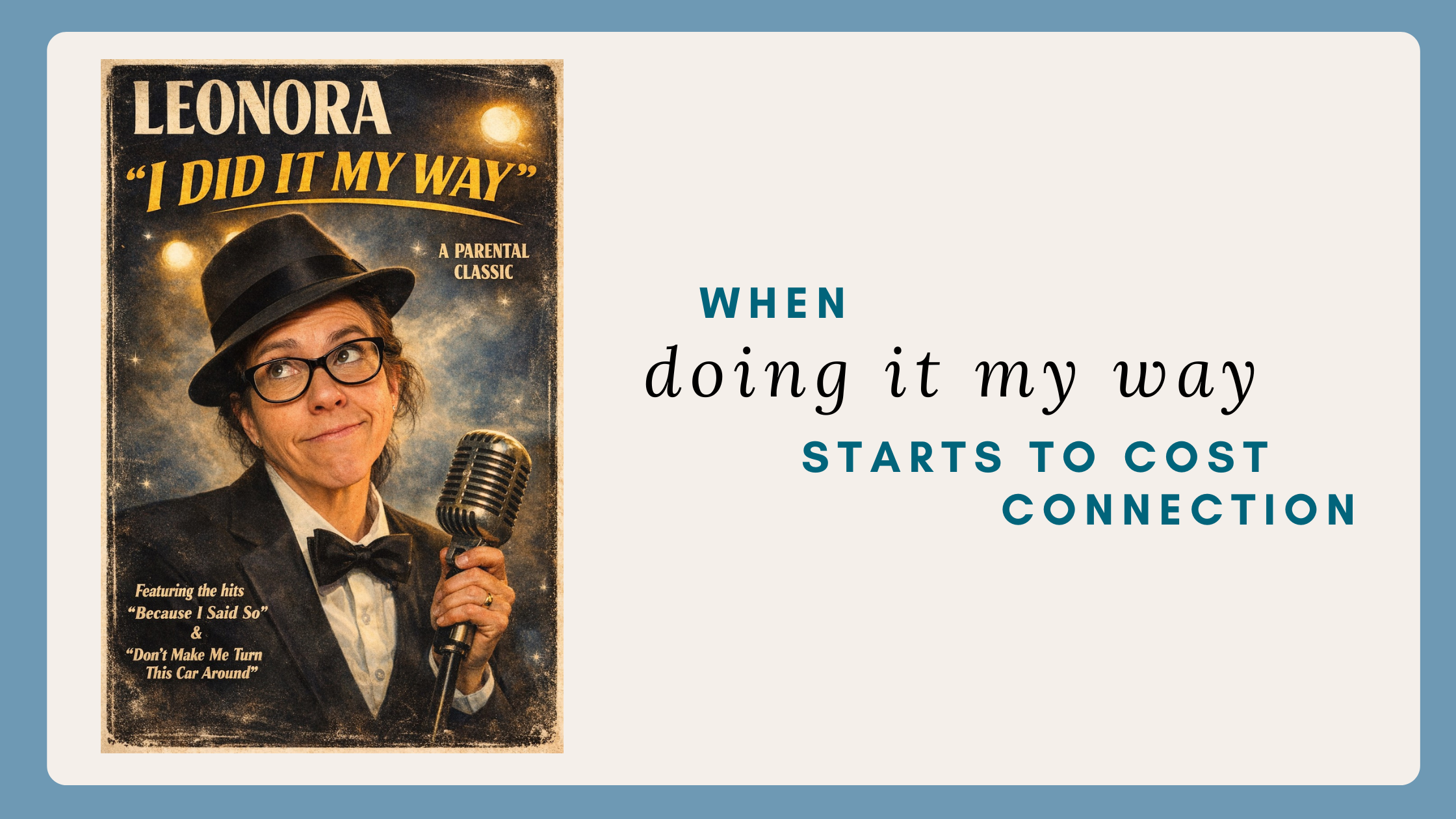
“I’ll do it my way.”
It’s a phrase that sounds bold and independent, almost romantic in a Sinatra sort of way, but in parenting, it begins far more practically.
From the very start, the responsibility sits squarely with us.
In those early years, it was, quite reasonably, ‘my way’. The kids could not negotiate bedtime or debate the merits of puréed vegetables versus toast soldiers, so the direction came from me. As they grew, it remained largely my way, just a slightly looser version. Otherwise we would have been living on Oreo cookies dipped in milk and calling 10:47pm an acceptable bedtime.
Guidance and direction are part of parenting. I do not regret that.
What I have been questioning this week is when “my way” quietly became gospel. Somewhere along the line my preferences hardened into principles, my opinions turned into standards, and my suggestions began sounding suspiciously like instructions.
That shift is subtle. It does not announce itself. It simply settles in.
When Control in Parenting Feels Like Protection
It is easy to label this as control, and yes, control plays a part. But control in parenting rarely begins with ego. More often it begins with care.
There is the instinct to protect because we don’t like watching our children struggle. There is also the worry that if we loosen our grip, they might make choices that cost them unnecessarily. And woven through it is the very human assumption that we probably do know best.
After all, we have lived longer, made more mistakes already, and very likely, can see the potholes in the road ahead.
But knowing where the potholes are does not mean we can walk the road for them.
That tension between guidance and control in parenting has been following me around.
A-Levels, Assumptions, and Pressure
My son is studying for his A-levels. He has his way of revising. And I have what I consider to be a better way.
You can imagine how that dynamic unfolds.
He pulls back. I lean in. He grows quieter. And I become more insistent. I tell myself that I’m supporting him, but that support feels more like pressure.
At one point he introduced me to the term “schizophrenogenic mum.” Ouch.
The term comes from an old and now widely disputed psychological theory suggesting that certain patterns of parenting, particularly communication that is contradictory, over-involved or emotionally confusing, could contribute to serious mental distress. It is not a recognised diagnosis today, and the theory itself has largely been discredited. Even so, the essence of what he was pointing to was clear enough: my intensity was landing as overwhelming rather than helpful.
His intent wasn’t to hurt me. Rather, it was a cry for help. ‘I’m trying to work it out, Mom. That’s what I’m supposed to be doing. Your role is to support from the wings.’ It seems I missed that.
In that moment, I had to confront something uncomfortable about control in parenting. My effort to protect has become pressure, my desire to help, a heaviness.
The Cost of Control in Parenting
What I am grateful for is that we have spent years building the language to come back from moments like this. We were able to sit down, untangle what was actually happening, and find a steadier ground where neither of us needed to win.
That conversation reminded me that being right and being connected are not the same thing.
Control in parenting can secure compliance in the short term, but over time it has a way of quietly eroding connection. I can insist on doing it my way and win the argument, yet in doing so risk losing the closeness that matters far more.
Or I can choose curiosity.
What Helped Me Loosen My Grip
Listening requires more than silence. It requires us to set aside our internal scripts about what is right or wrong long enough to genuinely understand what is happening for our children.
It invites us to trust that struggle is not the enemy of growth. It asks us to loosen our grip without stepping out of our role.
There is a difference between guiding and gripping, and many of us are still learning where that line sits.
Practical Takeaways If You’re Navigating Control in Parenting
If you recognise yourself in this dynamic, here are a few gentle reflections to consider:
1. Notice the Lean-In Pattern
If your child withdraws while you intensify, pause. That pattern often signals that control in parenting may be tipping into pressure.
2. Separate Protection from Control
Protection creates safety. Control creates tension. The intention may be loving, but the impact matters more.
3. Question the “I Know Best” Narrative
Experience gives perspective. It does not give ownership of their journey.
4. Prioritise Connection Over Correction
Correction shapes behaviour. Connection shapes trust and long-term influence.
5. Allow Struggle
Struggle is not failure. It is often where competence and confidence are built.
Moments like this are exactly why I wrote I’m Fine.
Not because I have mastered parenting, but because I am living it in real time. The book explores these quiet tensions across every stage of family life, the places where our need to protect can slowly morph into pressure, and how we find our way back to presence rather than perfection.
Parenting does not require us to abandon leadership. It does ask us to examine it.
Sometimes doing it “my way” is necessary but sometimes, loosening control is braver. I am still learning which is which.