The benefits of Life Long Learning
Thinking of exercising your brain’s muscle? The good news is that it’s never too late. The alternative is to continue with bland daily routines subconsciously inviting your brain into the slippery slope of stagnation. This sounds rather dramatic but there are major benefits to inviting in the stretch and taking on a mindset of life long learning.
Since your brain is like a muscle – the more you use it, the stronger it gets. When you learn something, new neural connections are created, which improves your capacity to remember. Regardless of your age, mental exercise has an overall positive effect on your brain.
Some of the benefits include :
- Sharpening your memory
- Boosting confidence.
- The opportunity to learn new skills
- The discovery of new hobbies, habits and interests
- Modeling the value of learning to your children.
- Aiding wellbeing.
- A drie in innovation.
At fifty-two, I have discovered that my brain is alive and well…something I’d previously doubted. The story I had told myself and which my brain tried to validate, is that menopause and being of a certain age would create brain fog and a deterioration in ability. This couldn’t be further from the truth. Like a muscle, it needs activation, strengthening and regular conditioning.
5 Ways to practice Life Long Learning
-
Engage the brain.
Regardless of your age, mental exercise has an overall positive effect on your brain. Without it, cognitive performance suffers.
-
Learn something new
The brain finds comfort in repetition. Enhancing as crosswords, sudoku and building puzzles are, what the brain needs most to fire up its cylinders is a challenge and new forms of stimulation.
-
Practice mindfulness.
Mindfulness starts with a blank canvas. Our daily lives revolve around fast passed routines. We rarely stop and take time to think. It’s from this space that innovation and creativity come to life.
-
Read often.
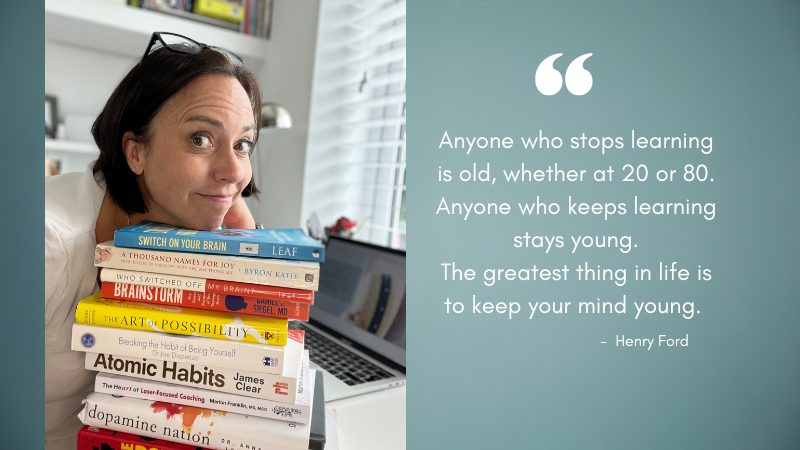
Reading was something I rarely had time for. It’s now become a daily habit. And an emprovement on this has been ridding myself of the need to finish a book immeidatley. Instead, I dabble. I read a little here and a little there – all sorts of things to awaken my curiosity and expand my interests.
-
Make use of digital learning.
There is plenty… PLENTY available at the end of your fingertips and a lot of it is free. Much of my daily learning takes place in this way.
- Podcasts
- Ted Talks
- Facebook group Memberships
- Free Masterclasses
- Free Taster Sessions
- Online Courses
- Focus Groups, and the list goes on.
The flip side of Life Long Learning
The idea of lifelong learning enables you to keep pursuing your personal and professional developmental goals. This leads to many achievements and a greater sense of happiness.
The flip side is that people who don’t give enough attention to stimulating brain development end up feeling unfulfilled and unmotivated. Exploring interests and working on personal growth may be the spark that ignites some previously dormant areas of your brain.
Elderly people who spend less time on learning are likely to experience faster cognitive degeneration than those who learn regularly.
A final thought,
We all experience stress in life. Daily worries are often things we have little control over. Giving your brain something else to focus on may be what breaks the pattern of perpetual worry. It forces the brain to think about something more desirable.
Is there a skill you’d like to learn or an opportunity worth exploring? Do you have an interest in something but haven’t allowed yourself the time to explore it? What’s preventing you from trying something new? You may be surprised at where the answers to these questions lead you.
💡 Life long learning for you.Try doing something intellectually stimulating every day. This may be different for each person. The key is to think about something you enjoy. It may take the form of reading, keeping in touch with current events, having a deep conversation, exploring a new practical skill or enrolling in a new course to study something that interests you. Consider the blank canvas and start there. |
A curious mind is the best one.
Show your intent, ask questions, keep reflecting, be inquisitive and keep the momentum going.
It’s worth remembering that it is learning that helps you acknowledge that you can learn new skills and improve your chances of success. Everything is possible with the right attitude.